
How Much Does a Small Business Website Cost in 2026?
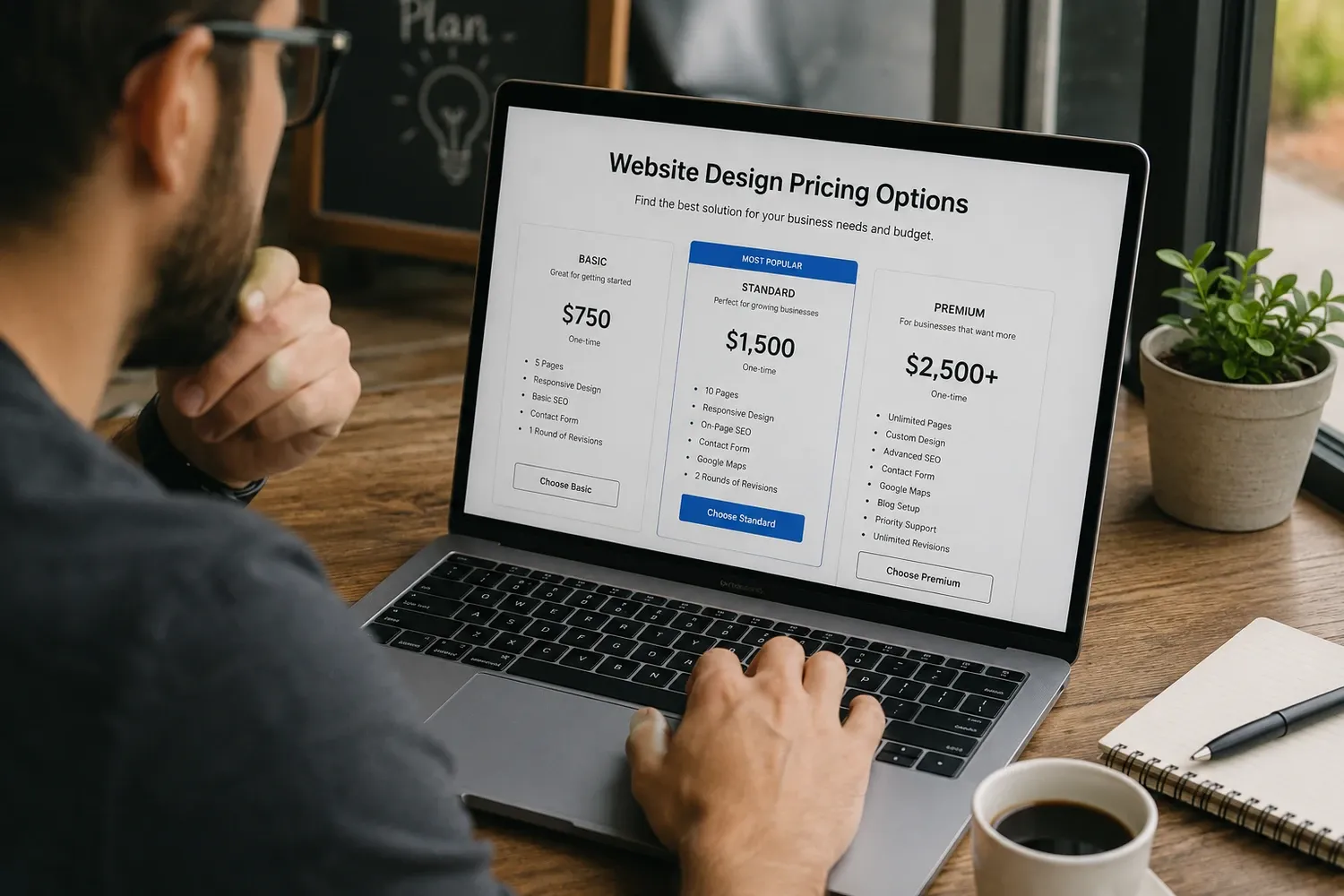

Ask five people what a website costs and you’ll get five different numbers — $200, $2,000, $20,000, all technically correct. The gap comes down to who’s building it and what’s actually included. This guide breaks down small business website cost by option, what you get at each price point, and the ongoing costs most quotes leave out.
Small Business Website Cost at a Glance
Here’s the short version. The rest of this guide explains what drives the range and which option fits your business.
| Option | Typical Cost | Best For | Turnaround |
|---|---|---|---|
| DIY website builder (Wix, Squarespace, Shopify) | $0–$50/month | Brand-new or very early-stage businesses | Days |
| Freelance marketplace (Fiverr, Upwork) | $200–$1,500 | Basic needs, fast turnaround, low budget | 1–3 weeks |
| Independent freelance web designer | $1,500–$6,000 | Small businesses that want a custom site and a real process | 3–6 weeks |
| Web design studio or partner | $5,000–$20,000+ | Businesses that want strategy, copy, and SEO built in, not just pages | 6–12 weeks |
What Actually Affects Website Cost
The price gap isn’t really about how many pages a site has. It’s about everything around the build:
- Custom design vs. template. A theme you drag content into costs less because someone else already did the design work — and thousands of other sites are using the same layout.
- Number and type of pages. A five-page brochure site is a different project than a site with booking, e-commerce, or a client portal.
- Copywriting. Some quotes include writing the actual words on the page. Others hand you a blank template and expect you to fill it in.
- Strategy and structure. A partner who plans your site around what makes a visitor become a customer charges for that thinking, not just the pages.
- SEO setup. Basic technical SEO — page titles, meta descriptions, site speed, mobile performance — takes real time to do properly and isn’t always included.
- Who’s doing the work. A solo freelancer, a marketplace gig worker, and a small studio all carry different overhead, and that shows up in the quote.
Website Cost by Option
DIY website builders ($0–$50/month)
Wix, Squarespace, and Shopify let you build and launch a site yourself using pre-made templates. It’s the cheapest, fastest path to being online. The tradeoff is time and design flexibility — you’re the one filling in every page, and you’re working inside a template thousands of other small businesses are also using. Reasonable for a very early-stage business testing the waters.
Freelance marketplaces ($200–$1,500)
Fiverr and Upwork connect you with individual designers and developers at a wide range of skill levels. You can get a solid site here if you vet carefully — look for original portfolio work, not template flips, and read reviews that mention communication and post-launch support. The risk is inconsistency: quality swings widely from one seller to the next, and cheap listings often mean a template with your logo dropped in.
Independent freelance web designers ($1,500–$6,000)
This is where most small businesses get the best value. You’re paying for an actual process: a designer who asks about your business and your customers before opening any design software, builds a custom layout around your content, and is reachable when something needs updating later. You typically get a site built to fit the business, not squeezed into a template.
Web design studios and partners ($5,000–$20,000+)
At this level, the website is treated as part of the business, not just a digital brochure — strategy, copywriting, SEO setup, and design work together toward getting visitors to actually reach out. This is the right tier if the site needs to carry real weight: lead generation, e-commerce, or a brand that’s actively growing. I cover this kind of work through my web design services, where the goal is a site that makes the next step obvious, not just one that looks good.
What You Actually Get at Each Price Point
- Under $500: A template with your content dropped in, minimal customization, little to no SEO setup, and you’re usually on your own for edits after launch.
- $500–$1,500: A handful of custom pages, basic mobile optimization, limited revisions. Quality depends heavily on the individual seller.
- $1,500–$6,000: A discovery conversation, custom layout and design, structured revisions, basic SEO setup, and a site you actually own and can hand off.
- $5,000+: Strategy, professional copywriting, full SEO foundation, and a build process that treats the site as a growth tool, not a checklist item.
Hidden Costs Most Quotes Leave Out
The build price is rarely the whole story. Before you commit to a number, confirm what’s covered separately:
- Domain name: around $10–$20 per year.
- Hosting: roughly $10–$50 per month, though some agencies bundle this into a monthly plan.
- Ongoing maintenance: software updates, backups, and security patches — either a monthly fee or an as-needed cost if something breaks.
- Stock photography or custom images: free to a few hundred dollars, depending on whether you supply your own.
- Copywriting: if it’s not included in the build, expect $500–$3,000 depending on page count.
- E-commerce or booking tools: often a separate monthly subscription on top of hosting.
Red Flags That Cost You More Later
- You don’t get ownership. If the site lives on the developer’s hosting account and you can’t get admin access or move it elsewhere, you don’t actually own your website.
- No mobile testing. A site that wasn’t checked on an actual phone will often break on one, and most of your visitors are on mobile.
- Maintenance costs appear after launch. If ongoing fees weren’t mentioned upfront, ask before you sign anything.
- Obvious template reuse. If the layout looks identical to five other local business sites, it probably is.
- Turnaround that’s too fast to be real. A custom site delivered in 48 hours usually means no one asked about your business first.
How to Budget for a Small Business Website
A reasonable starting point for most small businesses is $1,500–$6,000 for a custom-built site with an independent designer, or $5,000–$15,000 if you want strategy, copywriting, and SEO handled as part of the build. On top of that, plan for $20–$100 a month in ongoing hosting and maintenance — a website isn’t a one-time purchase the way a logo is.
Before you reach out to anyone, get clear on your budget range, how many pages and features you actually need, and whether you want copywriting handled for you or plan to write it yourself. If you’re pricing out a full identity at the same time, it’s worth reading how logo design and branding cost is typically structured too, since the two are often budgeted together.
If you’d rather see real project examples before deciding on a budget, browse recent website design projects to get a sense of what different price points actually produce.
Frequently Asked Questions
How much should a small business budget for a website?
Most small businesses land between $1,500 and $6,000 for a custom-built site with an independent designer. Add $5,000–$15,000 if you want strategy, copywriting, and SEO built in as part of a fuller partnership.
Is a $200 Fiverr website worth it?
It depends on your goal. As a quick placeholder while you get a business off the ground, it can work. As the permanent home for a growing business, it’s a risk — you’re more likely to end up with a template site, limited support, and no real SEO foundation.
Do I need to pay monthly for hosting and maintenance?
Yes, in most cases. Hosting typically runs $10–$50 a month, and ongoing maintenance (updates, backups, security) is either a smaller recurring fee or an as-needed cost. Factor this in separately from the build price.
How long does it take to build a small business website?
Plan on 1–3 weeks for a marketplace build, 3–6 weeks for an independent designer, and 6–12 weeks for a full studio project that includes strategy and copywriting.
Should I use a website builder like Wix, or hire a designer?
A builder makes sense if you’re testing an idea or need something online immediately on a near-zero budget. If the website needs to actually bring in customers, a designer who builds around your business — not a template — will outperform it.
Getting a Website Built Around Your Business
The right website budget isn’t the cheapest number you can find — it’s the number that matches what the site actually needs to do. A placeholder page and a site built to bring in customers for years are different projects, and that’s fine as long as you know which one you’re buying.
If you’re ready for a site built around your actual business, not a template, I’d be glad to help. Take a look at my web design services, or get in touch to talk through your project and get a straightforward quote.
Let's Talk About Your Project
Fill out the form with a few details about your project, and I'll get back to you with the next steps.